Choosing among the top Aluminium Front Door manufacturers in China requires more than comparing photographs and quoted prices. A reliable manufacturer should demonstrate practical experience, stable production systems, and clear technical documentation. Important details include aluminium alloy grades, thermal-break profiles, powder-coating thickness, glazing options, drainage design, and hardware performance. These features affect insulation, security, appearance, and service life.
Factory visits, video inspections, and independent sample checks can reveal details that catalogs often hide. Look for clean welding areas, protected glass edges, accurate corner joints, and consistent surface finishes. Ask whether the manufacturer performs air, water, wind-pressure, and opening-cycle tests. Certification can support credibility, but its scope and validity still require verification. A certificate alone is not proof.
Regional experience also matters. Doors installed near coastal areas need stronger resistance to salt exposure, while colder regions require careful attention to thermal bridging and weather seals. Experienced suppliers should explain these differences without relying on vague promises. They should also provide shop drawings, packing photos, installation guidance, and responsive after-sales communication.
Price matters, but it should not lead the decision. A lower quotation may exclude reinforced frames, premium hardware, protective packaging, or installation support. That omission can become expensive later. The best choice depends on project needs, not reputation alone. Even this review has limits; manufacturing quality can change, and online information may become outdated. Buyers should request recent samples, production evidence, references, and written specifications before selecting a partner. Clear evidence builds trust. Reliable doors begin with reliable questions.
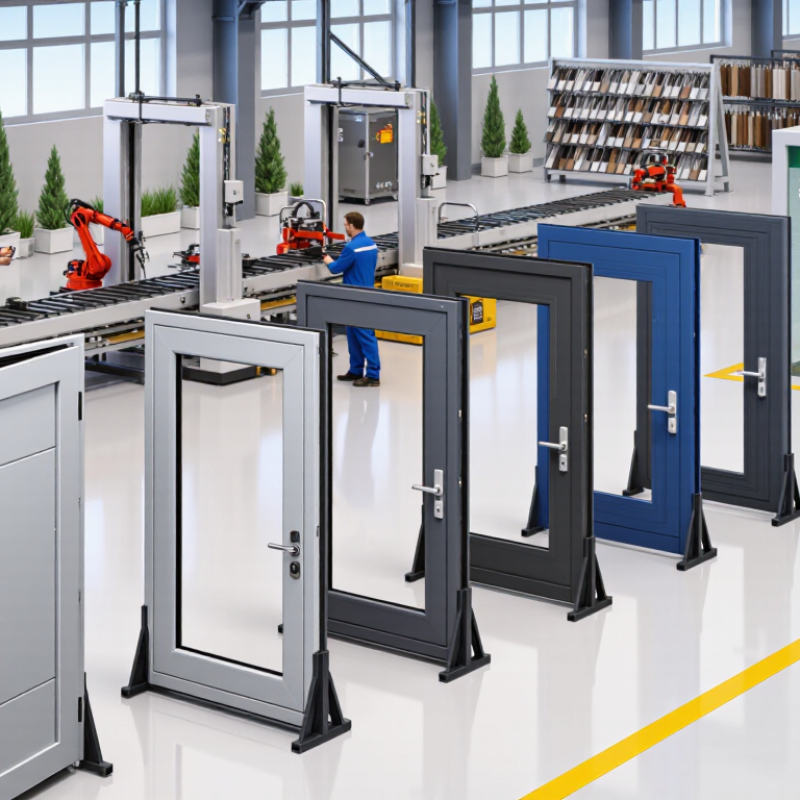
Top Aluminium Front Door Manufacturers in China
Aluminium Front Door Manufacturing in China: An Industry Overview
China’s aluminium front door industry combines large-scale production with increasingly customized architectural design. Manufacturers commonly operate in established metalworking regions, supported by extrusion, glass, hardware, and surface-finishing suppliers. This supply network can shorten production cycles and improve component compatibility.
Experienced factories usually manage the process from profile cutting to final inspection. Thermal-break aluminium systems help reduce heat transfer around the entrance. Powder coating, anodizing, and wood-effect finishes provide different visual and weathering options. CNC machining also supports precise hinge, lock, and panel preparation.
Quality depends on more than attractive samples. Buyers should review alloy specifications, coating thickness, glass configuration, drainage design, and hardware testing records. Reliable manufacturers can provide drawings, sample approvals, inspection photographs, and clear packing procedures. Factory visits or independent inspections add useful evidence, especially for large projects.
Lead times vary with door size, finish, glass, and hardware availability. Standard models may move faster than heavily customized entrances. Communication matters. Small drawing errors can affect installation on site.
No factory is perfect. Some suppliers may present polished showrooms but weaker documentation. Others offer strong engineering but limited design flexibility. A practical evaluation should compare production experience, quality controls, export procedures, and after-sales responsiveness rather than price alone. Real project references reveal details that brochures often miss, including corner alignment, seal performance, and packaging durability.
Chinese aluminium front door manufacturers stand out through practical engineering, flexible production, and strict quality checks. Leading suppliers usually combine extrusion, machining, finishing, and assembly under controlled systems. Their engineers inspect profile thickness, corner joints, hinge positions, and drainage paths. These details influence how the door performs after years of opening and closing. Small tolerances matter.
A key feature is the use of thermally broken aluminium profiles. They reduce heat transfer and help limit condensation around the frame. Multi-point locking systems improve resistance against forced entry and daily wear. Weather seals should remain flexible across changing temperatures. Powder-coated or anodized finishes offer better protection from sunlight, rain, and surface scratches. Reliable factories test coating adhesion, water resistance, and hardware operation. Ask for inspection records.
Customization is another important strength. Manufacturers can adjust door sizes, glass types, panel designs, colors, and opening directions for different projects. Good technical teams provide shop drawings before production. They should also explain wall conditions and installation tolerances clearly. Packaging deserves attention, too. Foam corners and reinforced crates reduce damage during shipping. Some suppliers offer installation guidance and replacement hardware, but service quality can vary. A polished sample may hide weak internal reinforcement. Buyers should compare cross-sections, test data, and production photos, not only showroom appearance. The overlooked detail often becomes the costly repair.
Choosing among the top aluminium front door manufacturers in China requires more than comparing online photos. A reliable evaluation starts with factory evidence. Ask for alloy specifications, powder-coating standards, thermal-break details, and hardware test records. Request a sample before placing a large order. Check corner joints, drainage holes, hinge alignment, and surface consistency under natural light. A beautiful catalogue can hide uneven finishing. It happens.
Factory experience matters when doors have unusual sizes, heavy glazing, or complex opening systems. Ask how the manufacturer handles design changes, replacement parts, and quality claims. Clear drawings should show profiles, glass thickness, tolerances, and installation conditions. Independent inspection can verify dimensions and packing quality before shipment. Do not rely only on certificates. Their scope and validity must match your project and destination requirements. Communication is also evidence of professionalism. Delayed replies may create larger problems during production.
Tips: Compare at least three factories using the same specification sheet. Visit the production line, physically or through a live video call. Inspect extrusion storage, cutting accuracy, assembly benches, and finished-door protection. Request recent project references, but confirm them independently. Review payment terms, delivery schedules, warranty limits, and after-sales response times in writing. My own assessment would still include a weakness: a small sample cannot reveal every long-term issue. Seasonal weather, installation skill, and building movement can change performance. Keep those risks visible before choosing a manufacturer.
| No. | Evaluation Dimension | Recommended Benchmark | Evidence to Request | Weight | Score 1–5 | Assessment Note |
|---|---|---|---|---|---|---|
| 1 | Product Compliance | Products should be tested or documented against the requirements of the destination market, such as EN 14351-1 for external pedestrian doorsets or applicable ASTM/AAMA methods for North American projects. | Test reports, declarations of performance, technical datasheets, and applicable product certifications. | 15% | __/5 | Give priority to reports issued by independent, accredited laboratories. |
| 2 | Aluminium Alloy and Profile Quality | Profiles should have a clearly stated alloy and temper, consistent wall thickness, accurate dimensions, and adequate reinforcement for the selected door size and hardware. | Alloy and temper information, profile drawings, material inspection records, and section samples. | 10% | __/5 | Do not evaluate quality from surface appearance alone; verify the profile specification. |
| 3 | Thermal Performance | Thermally broken systems are generally preferable for heated or cooled buildings. Compare whole-door U-value or Ud data rather than frame-only figures. | Whole-door thermal calculations or test reports, thermal-break material details, and glazing specifications. | 12% | __/5 | Lower U-value indicates better thermal insulation, subject to the local climate and code. |
| 4 | Air, Water and Wind Resistance | The doorset should have documented air-leakage, water-penetration, and structural-performance results appropriate for the project location and exposure. | Test results using relevant methods such as ASTM E283, ASTM E331, ASTM E330, or equivalent regional standards. | 12% | __/5 | Check that the tested configuration matches the proposed size, glass, hardware, and threshold. |
| 5 | Surface Finish and Corrosion Protection | The finish should be suitable for the intended environment, with controlled pretreatment and documented coating or anodizing specifications. | Powder-coating or anodizing specifications, color and gloss samples, pretreatment process records, and quality-control results. | 10% | __/5 | Coastal and industrial locations usually require more stringent corrosion protection. |
| 6 | Hardware and Security | The supplier should offer compatible hinges, locks, cylinders, multipoint locking systems, door closers, and access-control options for the specified door weight and use frequency. | Hardware schedule, load ratings, security test information, installation instructions, and replacement-part availability. | 10% | __/5 | Hardware compatibility is essential for large, heavy, or frequently used front doors. |
| 7 | Manufacturing Quality Control | A reliable factory should control incoming materials, cutting, machining, assembly, glazing, sealing, dimensional accuracy, and final inspection. | Quality-control plan, inspection checklist, process photographs or video, sample inspection report, and corrective-action records. | 12% | __/5 | A documented process is more reliable than a visual factory tour alone. |
| 8 | Customization Capability | The manufacturer should be able to manage custom dimensions, opening directions, glazing, thresholds, transoms, sidelights, colors, and project-specific hardware. | Shop drawings, section details, engineering review procedure, sample approvals, and maximum tested dimensions. | 8% | __/5 | Custom work should be supported by drawings and documented dimensional checks. |
| 9 | Production Capacity and Lead Time | The supplier should provide a realistic production schedule, confirm capacity for the required quantity, and identify material or hardware lead-time risks. | Production schedule, capacity statement, order milestones, packaging plan, and written lead-time quotation. | 6% | __/5 | Evaluate confirmed capacity rather than an advertised maximum output. |
| 10 | Packaging and Export Logistics | Doors should be protected against scratches, moisture, impact, and deformation during inland transport, container loading, and long-distance shipping. | Packaging specifications, loading photographs, carton or crate dimensions, shipping documents, and damage-claim procedure. | 5% | __/5 | Packaging should reflect the door size, glazing weight, and destination transport route. |
| 11 | Warranty and After-Sales Support | The supplier should define warranty coverage, exclusions, response times, spare-parts support, and responsibilities for installation-related issues. | Written warranty terms, service workflow, spare-parts list, installation guidance, and customer reference verification. | 10% | __/5 | A clear written process is preferable to informal promises. |
| Weighted Evaluation Result | 100% | __/5 | Use documented evidence for the final comparison. | |||
Top Aluminium Front Door Manufacturers in China
China’s leading aluminium front door manufacturers compete through engineering, customization, and production consistency. Their strongest products often combine thermal-break aluminium profiles, reinforced frames, and multi-point locking systems. These features help doors resist heat transfer, rain, wind, and frequent daily use.
Experienced factories usually offer several surface finishes, including powder coating, wood-grain textures, and anodized effects. Buyers can request slim sightlines, concealed hinges, glass panels, or oversized entrance designs. A reliable manufacturer should provide section drawings, material samples, load information, and clear hardware specifications. Factory inspections can reveal important details. Check corner joints, drainage paths, gasket placement, and coating thickness. Small details matter.
Manufacturers with stronger technical teams often use CNC cutting, automated welding, and controlled assembly lines. These methods improve dimensional accuracy across repeated orders. Some also test air infiltration, water resistance, wind pressure, and hardware endurance. However, production quality is not always perfect. A polished catalog cannot replace independent inspection or sample approval. I would compare several finished doors under the same criteria, rather than trusting the lowest quotation. Ask how the factory handles color variation, damaged components, installation guidance, and after-sales claims. Clear records build confidence. The best supplier is not simply the largest one, but the manufacturer that documents its process and responds precisely when problems appear.
Top Aluminium Front Door Manufacturers in China
Buying Considerations for Chinese Aluminium Front Door Suppliers
Selecting a Chinese aluminium front door supplier requires more than comparing catalogue prices. Start with project evidence. Request completed door photos, installation locations, and contactable references. Reliable suppliers explain alloy grade, profile thickness, thermal-break design, and surface treatment clearly. Ask for test reports covering air tightness, water resistance, wind load, and hardware cycles. Documents should match the proposed door system, not a similar model. Details matter.
Inspect samples under natural light. Look at corner joints, weld quality, drainage holes, hinges, locks, and gasket compression. Open the door repeatedly. Uneven movement often reveals poor alignment or weak hardware. Powder coating should feel even, without pinholes, color shifts, or sharp edges. Coastal projects need stronger corrosion protection. However, a beautiful sample can mislead. Request a production sample or factory video showing the same profile and finish. Independent inspection before shipment costs more, but it can expose packaging or assembly problems.
Clarify dimensions, glass specifications, swing direction, threshold height, and installation responsibilities in writing. Confirm packaging, replacement-part availability, lead time, warranty exclusions, and destination-market compliance documents. Payment milestones should connect to measurable stages, such as drawing approval and inspection. Do not accept vague promises. Remote quality checks cannot replace local installation expertise. Budget for an experienced installer, especially when walls are uneven or openings are oversized. Small tolerances can affect sealing, security, and daily comfort.
The industry offers large-scale production and customized architectural designs. Many factories work near extrusion, glass, hardware, and finishing suppliers. This can shorten production cycles. It is not always faster.
A capable factory may handle profile cutting, CNC machining, assembly, and final inspection. These steps prepare hinges, locks, panels, and drainage openings accurately. Ask for production drawings and inspection photographs.
Thermal-break systems reduce heat transfer around the entrance. They can improve indoor comfort and energy performance. Actual results depend on glass, seals, installation, and local weather.
Common options include powder coating, anodizing, and wood-effect finishes. Each finish offers different visual and weathering characteristics. Check coating thickness and surface consistency under natural light.
Review alloy specifications, glass configuration, drainage holes, and hardware testing records. Inspect corner joints and hinge alignment on a physical sample. Small details matter.
Use one specification sheet for at least three factories. Compare drawings, samples, production controls, delivery terms, and warranty limits. Price alone gives an incomplete picture.
A physical visit can reveal extrusion storage, cutting accuracy, and assembly conditions. A live video inspection is a useful alternative. It still cannot show everything.
Lead times change with door size, finish, glass, and hardware availability. Small drawing errors may affect installation on site. Confirm profiles, glass thickness, tolerances, and opening directions in writing.
Independent inspections can verify dimensions, packing quality, and visible defects before shipment. Certificates alone may not cover every project requirement. Their scope and validity need careful review.
A polished showroom may hide weak documentation or uneven finishing. A strong engineering team may offer limited design flexibility. Samples cannot reveal every long-term issue. Installation skill and building movement still matter.
China’s Aluminium Front Door manufacturing industry has developed into a highly competitive sector, supported by advanced production capabilities, diverse design options, and efficient supply chains. Leading manufacturers typically focus on durable materials, thermal insulation, weather resistance, security performance, precise processing, and customizable finishes. Their product ranges may include modern, minimalist, traditional, and smart-ready door solutions suitable for residential and commercial projects.
When evaluating Aluminium Front Door manufacturers in China, buyers should examine material quality, manufacturing standards, design flexibility, quality-control procedures, production capacity, communication efficiency, and after-sales support. It is also important to compare quotations carefully, considering door structure, hardware, glass, surface treatment, packaging, delivery arrangements, and warranty terms. By assessing both product strengths and supplier reliability, international buyers can select a suitable partner that provides consistent quality, competitive pricing, customization support, and dependable long-term cooperation.