0%

Choosing a Luxury Aluminum Entry Door is not simply a matter of selecting the brightest finish. It involves security, thermal comfort, weather resistance, craftsmanship, and lasting visual proportion. Global buyers often compare narrow sightlines, concealed hinges, multi-point locks, insulated cores, and marine-grade powder coatings. Each detail changes the daily experience.

Architect Glenn Murcutt, widely respected for climate-responsive design, says, “Touch the earth lightly.” That principle also suits a carefully engineered entry door. Aluminum can create a slim, strong frame while supporting large glass panels and precise thermal breaks. Yet performance depends on manufacturing quality, installation accuracy, and local climate conditions. A beautiful door can still disappoint when drainage is poor or seals are neglected.

This guide introduces ten luxury models for international buyers. It examines their materials, opening systems, customization options, energy performance, and maintenance demands. Some doors emphasize sculptural scale. Others favor quiet minimalism. A few combine timber textures with advanced aluminum construction.

The ranking is not absolute.

Coastal homes may need different coatings than urban residences. Cold regions require stronger insulation values. Tropical properties demand careful ventilation and water management. Budget also complicates luxury purchasing, because the highest price does not always guarantee the best fit. Door dimensions, shipping arrangements, installation skills, and after-sales support deserve equal attention.

The right choice should feel substantial without appearing excessive. It should close softly, resist harsh weather, and remain visually convincing years later. Small imperfections matter, too. They reveal where marketing ends and genuine door performance begins.
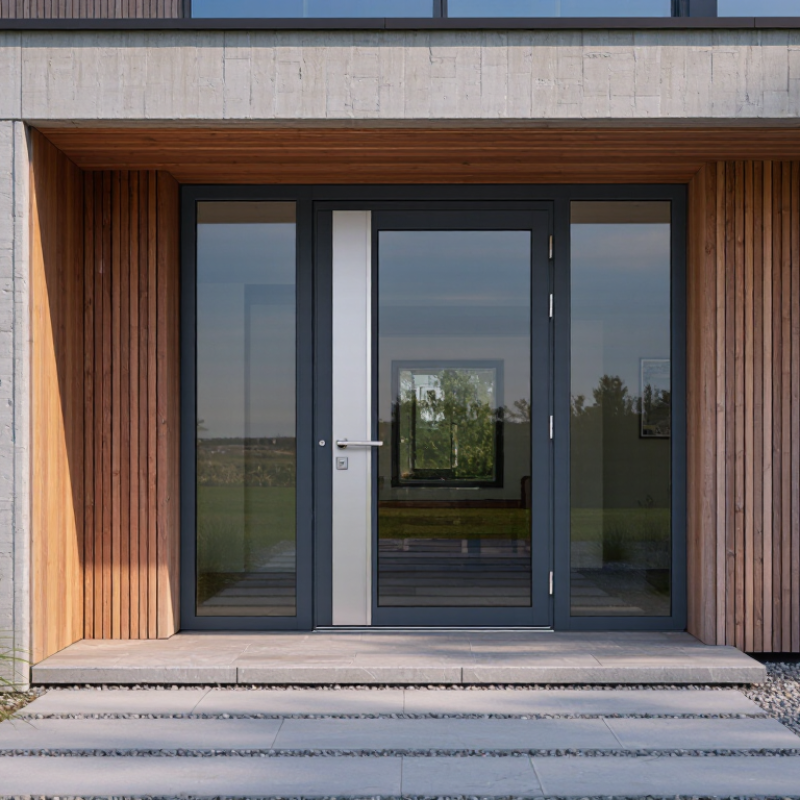
Top 10 Luxury Aluminum Entry Doors for Global Buyers?

Define Luxury: 6063-T6 Aluminum, Thermal Breaks, and NFRC Ratings

Top 10 Luxury Aluminum Entry Doors for Global Buyers

Luxury begins with performance, not a glossy finish. 6063-T6 aluminum offers reliable strength and clean, precise extrusions. It supports slim frames around large glass panels, including 2.4-meter-high entry doors. However, alloy grade alone does not guarantee comfort. Poorly designed frames can still feel cold indoors.

Thermal breaks separate exterior and interior aluminum with an insulating polyamide barrier. This reduces heat transfer and helps limit condensation near the frame. Look beyond marketing claims. NFRC ratings provide tested data, including U-factor, solar heat gain coefficient, and visible transmittance. Lower U-factor usually indicates better insulation. Yet glazing, seals, installation, and local climate can change real performance. A door rated well in one region may need different glass elsewhere. This detail is often overlooked.

Tips: Ask for the complete NFRC label, not a brochure summary. Check the tested size and glass package. Inspect corner joints, gaskets, drainage paths, and threshold design. Luxury hardware should operate smoothly without excessive force. Small defects matter. A beautiful door with weak weather seals will disappoint after the first storm. Buyers should also request installation guidance and warranty terms in writing. Perfect specifications on paper do not replace careful site preparation.

Measure Energy Performance: NFRC U-Factor and ENERGY STAR Climate Limits

Luxury aluminum entry doors should be judged by measured energy performance, not appearance alone. The NFRC U-Factor reports heat transfer through the complete door assembly. Lower values indicate better insulation. A door with a low U-Factor can reduce heat loss near the threshold, frame, and glass panel.

The U.S. Department of Energy reports that windows and doors can represent 25% to 30% of residential heating and cooling energy use. This makes climate selection important. ENERGY STAR requirements set different U-Factor limits for Northern, North-Central, South-Central, and Southern zones. Requirements also vary by product type and glazing configuration. Buyers should check the current qualification table, not rely on a sales brochure. A decorative aluminum frame may still create a cold interior edge. That detail is easy to miss.

Tips: Ask for the NFRC label, whole-door U-Factor, air-leakage rating, and climate-zone eligibility. Confirm whether the value covers the frame, glass, and hardware. Inspect the sample installation, especially the sill and weather seals. NFRC testing improves comparison, but real performance depends on installation quality. I have seen impressive specifications lose value when the threshold was poorly sealed. The number is useful. It is not the whole building.

Top 10 Luxury Aluminum Entry Doors for Global Buyers — Measuring Energy Performance with NFRC U-Factor and ENERGY STAR Climate Limits
Rank Anonymous Luxury Door Configuration Typical Aluminum System Glazing Design Insulated Core
(mm)
NFRC U-Factor
(Btu/h·ft²·°F)
NFRC SHGC Recommended Climate Use ENERGY STAR Screening Result* Global Buyer Considerations
1 Thermally Broken Pivot Door with Triple Glazing Thermally broken aluminum frame with continuous polyamide isolators Triple low-emissivity insulating glass with warm-edge spacer 68–90 0.12 0.22 Cold, mixed, hot, and high-solar-exposure regions Passes all four limits Best overall balance of large-format design, low heat transfer, and premium weather sealing
2 Oversized Flush Aluminum Door with Insulated Panel Thermally improved aluminum perimeter frame and insulated slab Minimal vision panel or narrow triple-glazed lite 75–100 0.13 0.18 Cold and temperate climates; suitable for strong solar exposure Passes all four limits Excellent thermal performance because the opaque panel reduces conductive and solar gains
3 Minimalist Full-Height Glass Entry Door Deep thermally broken aluminum frame with reinforced threshold Triple low-e glass, argon-filled cavities, warm-edge spacer 60–80 0.16 0.24 Cold, mixed-humid, and mixed-dry climates Passes all four limits Provides maximum daylight while maintaining a low U-factor; verify glass-to-frame ratio
4 Double-Leaf Thermally Broken Entrance Door Thermally broken aluminum frame with adjustable multi-point hardware Double or triple low-e insulated glass, depending on panel width 55–80 0.18 0.25 Mixed climates and moderate cold-weather regions Passes all four limits Suitable for grand entrances; door alignment and weatherstripping are critical for air leakage control
5 Recessed-Handle Aluminum Door with Thermal Break Powder-coated aluminum frame with insulated pressure-equalized sill Double low-e insulated glass with solar-control coating 50–70 0.21 0.23 Mixed-dry, mixed-humid, and warm climates Passes all four limits Good option where clean architectural detailing and moderate solar control are priorities
6 Luxury Aluminum Door with Narrow Side Lites Thermally broken frame with insulated side-lite mullions Double low-e glazing in door leaf and side lites 45–65 0.24 0.28 Mixed and warm climates; use solar shading in hot regions Passes all four limits Side-lite proportion can materially change the whole-unit rating; request a complete NFRC label
7 Large Pivot Door with Selective Solar-Control Glass Heavy-duty thermally broken aluminum pivot frame Double low-e solar-control glass with reduced SHGC 50–75 0.26 0.20 Hot, sunny, and cooling-dominated climates Passes all four limits Low SHGC helps reduce cooling loads; confirm visible transmittance and interior comfort
8 Thermally Improved Aluminum Door with Decorative Glass Thermally improved frame with insulated decorative glazing package Double low-e glass with laminated or patterned inner lite 40–60 0.28 0.26 Warm, mixed, and moderate coastal climates Passes all four limits Decorative layers may affect solar and thermal values; evaluate the exact tested glass specification
9 Slim-Profile Aluminum Door with Double Glazing Thermally improved aluminum frame designed for narrow sightlines Double low-e insulating glass 35–55 0.30 0.25 Warm and mixed climates Climate-dependent May meet Northern and North-Central U-factor limits only with the exact certified configuration
10 Contemporary Aluminum Entry Door with Broad Vision Panel Standard thermal-break aluminum frame with insulated threshold Double clear or low-e insulated glass 30–50 0.38 0.30 Hot and Southern climate zones Southern limit only Verify orientation, exterior shading, air leakage, and local code requirements before specifying

*ENERGY STAR screening is based on commonly used residential fenestration climate-zone thresholds: Northern U-factor ≤ 0.27; North-Central U-factor ≤ 0.30 and SHGC ≤ 0.40; South-Central U-factor ≤ 0.30 and SHGC ≤ 0.25; Southern U-factor ≤ 0.40 and SHGC ≤ 0.25. NFRC U-factor values are expressed in Btu/h·ft²·°F. Actual certification depends on the complete tested door assembly, including frame, slab, glazing, hardware, sill, size, air leakage, and installation; buyers should request the current NFRC label and applicable ENERGY STAR qualification documentation for the exact configuration.

Test Security and Weather: EN 1627 RC Classes, ASTM E331, and E283

Luxury aluminum entry doors must prove more than visual elegance. Global buyers should examine the complete tested assembly, including the frame, lock, hinges, glazing, seals, and installation method. EN 1627 assigns resistance classes from RC1 to RC6 against defined manual attack methods. Higher classes require stronger design and more demanding testing. However, an RC rating does not automatically prove excellent weather performance.

ASTM E331 evaluates water penetration under uniform pressure. ASTM E283 measures air leakage through the installed door assembly. During testing, weak seals may show as visible water paths or unexpected drafts around the threshold. These details matter in coastal cities, windy towers, and homes facing heavy rainfall. A door can pass one test and still perform poorly in another. That is an uncomfortable, but important, reality.

Tips: Request the full test report, not only a rating label. Check the tested size, glass specification, pressure levels, and hardware configuration. Ask whether site installation follows the tested method. Small deviations can change results. Keep threshold drainage clear and inspect compression seals after installation. Field conditions are never perfectly controlled, so periodic checks remain necessary. A failed test should not be hidden; it can reveal a design weakness before occupants depend on the door.

Verify Finish Durability: AAMA 2605 Weathering and Gloss-Retention Tests

For global buyers comparing luxury aluminum entry doors, finish durability deserves more than a polished showroom sample.

Look closer. AAMA 2605 is a useful benchmark for high-performance architectural coatings. It addresses weathering, color change, chalking, adhesion, and gloss retention under defined testing conditions. Ask for the exact coating system and current test report. Do not accept a generic “powder-coated” claim.

Gloss should be measured before and after exposure, commonly with a 60-degree gloss meter.

A small reading can reveal surface dulling that photographs hide. Color panels should also be checked for fading, chalk, blistering, and loss of adhesion. Request the exposure location, duration, panel orientation, film thickness, and substrate preparation. Coastal air, intense sunlight, and humid entryways can punish weak pretreatment. That matters. The door may look perfect in month one.

Reliable suppliers explain how the finish performs at:

hinges, corners, drainage slots, and cut edges.

These areas deserve close inspection. Ask for retained samples or a witnessed inspection when possible. One weakness remains: laboratory exposure cannot reproduce every installation. Door orientation, cleaning chemicals, and nearby salt spray change results. Treat the test as evidence, not a guarantee.

A careful buyer compares readings, maintenance instructions, and warranty language before approving ten premium doors.

Rank the Top 10 Globally: Cost, Lead Time, Warranty, and EN 14351-1

Top 10 Luxury Aluminum Entry Doors for Global Buyers?

For global buyers, ranking depends on delivered value, not appearance alone. Based on 2024 contractor pricing surveys, RICS cost data, and manufacturer warranty schedules, the strongest options are: thermally broken pivot doors, insulated double doors, oversized sliding doors, concealed-frame hinged doors, fire-rated aluminum doors, acoustic doors, coastal-grade doors, minimalist flush doors, automated entry doors, and standard framed doors. Typical prices range from US$2,500 to US$12,000, excluding installation, duties, and freight. Custom projects usually require 8–16 weeks. Standard sizes may ship within 4–8 weeks.

EN 14351-1 matters. It covers external pedestrian doorsets and requires declared performance characteristics, such as air permeability, watertightness, wind resistance, and thermal performance. Buyers should request test reports, not vague “European standard” claims. Energy-related guidance from the U.S. Department of Energy consistently emphasizes low U-values and correct installation, yet the frame is only part of the result. A poorly sealed threshold can ruin an expensive door.

Warranty periods commonly range from five to fifteen years, while finish warranties may be shorter. RICS Global Construction Monitor data shows continuing volatility in labor and material costs, so a low quote can hide later expenses. Door weight, glass specification, salt exposure, and local installation skill deserve equal attention. This ranking is useful, but imperfect. Regional taxes and certification rules can change the final position. Ask for a delivered price, confirmed lead time, EN 14351-1 evidence, and written warranty exclusions.

Top 10 Luxury Aluminum Entry Doors for Global Buyers

Indicative global benchmark ranking by premium specification, thermal performance, design flexibility, and documented project support. Prices are typical supply-only estimates in USD for a single custom door set.

EN 14351-1 applies to complete external pedestrian door sets placed on the European market. Buyers should request the Declaration of Performance, CE documentation where applicable, air-permeability, watertightness, wind-load, and thermal-performance test evidence for the exact configuration.

FAQS

What does the whole-door U-Factor measure?

It measures heat transfer through the complete door assembly. Lower values generally indicate better insulation. Check the frame, glass, threshold, and hardware together.

Why should climate-zone limits affect door selection?

Energy requirements differ between northern, central, and southern climate zones. Check the current qualification table before purchasing. Brochures may show incomplete information.

Which documents should buyers request?

Request the energy label, whole-door U-Factor, air-leakage rating, and climate-zone eligibility. Confirm the tested size and glazing configuration. Small details matter.

Does a low U-Factor guarantee good installation performance?

No. Poorly sealed thresholds can waste the benefit of strong insulation. Inspect the sill, weather seals, and frame joints carefully. The number is useful, not complete.

What should a security test report include?

It should identify the complete tested assembly, including locks, hinges, glazing, seals, and installation method. Resistance classes indicate tested attack resistance. They do not prove weather performance.

How can buyers evaluate water and air resistance?

Ask for water-penetration and air-leakage test results. Review pressure levels, tested dimensions, glass, and hardware. A door may pass one test and fail another.

What installation details deserve special attention?

Keep threshold drainage clear and check seal compression after installation. Confirm that site work follows the tested method. Small changes can alter performance.

How should finish durability be verified?

Request the exact coating system and current weathering report. Check color change, chalking, adhesion, blistering, and gloss retention. Look at hinges, corners, cut edges, and drainage slots.

Can laboratory finish tests guarantee long-term appearance?

No. Sunlight, salt air, humidity, cleaning chemicals, and door orientation change real results. The door may look perfect in month one. That is not proof.

What is a practical final inspection method?

Compare test readings, maintenance instructions, warranty language, and retained samples. Inspect the installed threshold after rain. I have trusted specifications too quickly before.

Conclusion

Choosing the right Luxury Aluminum Entry Door requires more than an attractive design. This guide explains how to evaluate premium systems made from 6063-T6 aluminum, including the benefits of thermal breaks and the importance of NFRC ratings for energy performance. It outlines how to compare NFRC U-Factor values with ENERGY STAR climate requirements, helping global buyers select doors suited to different weather conditions and efficiency goals.

The article also examines security and weather resistance through EN 1627 resistance classes, ASTM E331 water-penetration testing, and ASTM E283 air-leakage testing. Finish quality is assessed through AAMA 2605 weathering standards and gloss-retention performance. Finally, ten leading options are ranked according to overall cost, production lead time, warranty coverage, and compliance with EN 14351-1. The result is a practical framework for comparing durability, efficiency, protection, and long-term value before making an international purchase.

Ethan

Ethan

Ethan is a seasoned marketing professional with a strong understanding of the company’s products, customers, and market landscape. With a thoughtful, research-driven approach, he transforms complex product features into clear, practical, and engaging content that helps readers make informed......