Featured OEM Low-E Glass Front Doors & Architectural Entrance Systems
Direct from our 155,000 m² smart manufacturing plant. Precision-engineered for global commercial and high-end residential projects.
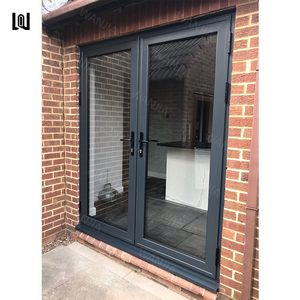
WANJIA Factory Customized Front Entry Aluminum French Doors Exterior Patio Glass Door
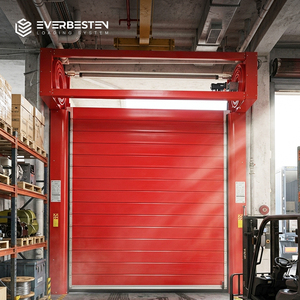
High Speed Spiral Door Aluminum Alloy Wind Resistant Exterior Entrance Door for Warehouse Logistics
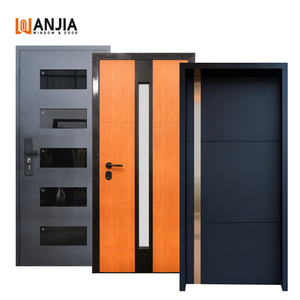
Contemporary Architectural Residential Exterior Entrance Door Soundproof Security Door
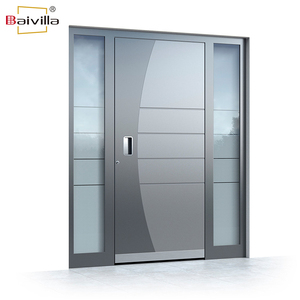
Custom Villa Exterior Entrance Security Door Smart Lock Password Electronic Glass Door
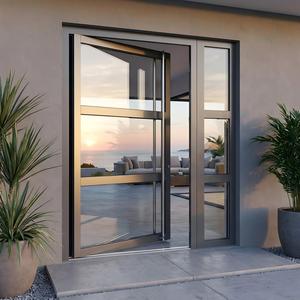
Modern Black Aluminum Pivot Door With Sidelights & Grids Design Large Villa Entrance System
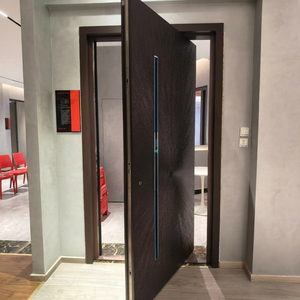
Custom Villa Entrance Door Modern Minimalist Cast Aluminum Art Carving Safety Door
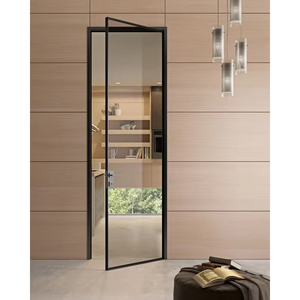
Modern French Design Narrow Frame Aluminum Glass Hinged Casement Door System
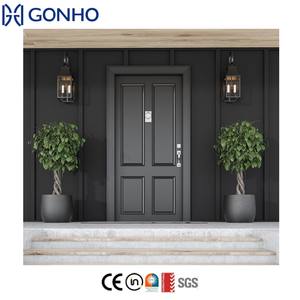
Fangda Design Villa Popular Modern Exterior Front Entry Door for Architectural Projects
The Science of Low-E Glass Front Doors: Thermal & Structural Performance
A deep technical analysis for architects, facade consultants, and procurement managers specifying high-performance exterior entrance systems for commercial and residential developments.
Low-Emissivity Physics
Microscopic nanometer silver layers sputtered on float glass reflect up to 96% of long-wave infrared thermal energy while maintaining transparent visible light transmission (VLT > 70%).
Thermal-Break PA66-GF25
Precision-extruded polyamide 66 reinforced with 25% fiberglass isolates inner and outer aluminum frames, eliminating conductive heat bridging and preventing internal condensation.
Structural Security & STC
Triple-glazed laminated glass units integrated with multi-point stainless steel deadbolt locking systems achieve STC 42+ acoustic damping and high forced-entry rating.
1. Spectrally Selective Low-E Glazing Technology in Modern Exterior Doors
In contemporary architectural design, the front door is no longer merely a point of physical ingress; it is a critical interface in the building envelope that dictates energy conservation, indoor environmental quality (IEQ), and structural resilience. Standard monolithic glass pane doors suffer from high thermal conductivity ($U$-factor $\approx 5.8 \text{ W/m}^2\text{K}$), leading to intense solar heat gain in warm climates and severe radiant thermal loss during winter periods.
Custom OEM Low-E (Low-Emissivity) glass front doors solve this thermodynamic challenge through magnetron sputtered vacuum deposition (MSVD) soft-coat coatings. By applying microscopic, atomically thin stacks of elemental silver ($\text{Ag}$) sandwiched between dielectric metal oxide layers (such as $\text{TiO}_2$ or $\text{ZnO}$), the glass acquires spectrally selective optical properties:
- Solar Heat Gain Coefficient (SHGC) Optimization: Low-E front doors can be tuned to SHGC values between 0.22 and 0.45 depending on regional solar irradiation levels, preventing passive thermal build-up inside foyer spaces.
- Emissivity ($\epsilon$) Reduction: Standard float glass exhibits an emissivity of $\epsilon \approx 0.84$. Advanced double-silver and triple-silver Low-E coatings reduce surface emissivity down to $\epsilon \le 0.03$, reflecting long-wave infrared heat back to its source.
- Insulated Glass Unit (IGU) Gas Filling: Encapsulating 90%+ pure Argon ($\text{Ar}$) or Krypton ($\text{Kr}$) inert gas within a 12mm to 16mm hermetically sealed airspace with warm-edge composite spacers further lowers the overall system U-factor down to $U \le 1.1 \text{ W/m}^2\text{K}$ (EN 673 standard).
Comparative Performance Matrix: Glazing Build-Ups for Entrance Doors
| Glazing Configuration | U-Value (W/m²K) | SHGC Range | Visible Light (VLT %) | Acoustic Rating (STC) |
|---|---|---|---|---|
| Single Pane Clear Float (6mm) | 5.78 | 0.82 | 88% | STC 28 |
| Standard Double Clear IGU (6+12Ar+6) | 2.72 | 0.70 | 78% | STC 34 |
| Single-Silver Low-E Double IGU (6 Low-E+12Ar+6) | 1.65 | 0.52 | 72% | STC 36 |
| Double-Silver Low-E Laminated IGU (6 Low-E+16Ar+6.38 PVB) | 1.25 | 0.32 | 65% | STC 41 |
| Triple-Silver Low-E Triple IGU (6 Low-E+12Ar+6+12Ar+6 Laminated) | 0.82 | 0.24 | 58% | STC 45 |
2. Thermal-Break Aluminum Profile Engineering & Structural Integrity
A high-performance Low-E glass panel loses its thermal efficacy if paired with a non-insulated aluminum frame, as raw extruded aluminum alloy ($\text{AlMgSi0.5}$ / 6063-T6) possesses an exceptionally high thermal conductivity of approximately $200 \text{ W/m}\cdot\text{K}$. To construct a fully compliant thermal barrier, OEM manufacturers integrate polyamide thermal break strips.
Our factory utilizes high-precision mechanical crimping to lock PA66-GF25 (Polyamide 66 reinforced with 25% structural glass fibers) struts directly between interior and exterior aluminum profile extrusions. This composite structure delivers:
- Structural Wind Load Resistance: Rated to withstand wind pressure dynamics up to 5,000 Pascals (ASTM E330 / AS 2047), making our Low-E glass doors suitable for high-rise residential towers and coastal villa applications.
- Differential Thermal Expansion Compatibility: The coefficient of thermal expansion of PA66-GF25 ($\alpha \approx 2.8 \times 10^{-5}/\text{K}$) closely matches aluminum alloys, ensuring structural bond integrity without seal degradation during extreme weather fluctuations ($-30^\circ\text{C}$ winter to $+80^\circ\text{C}$ surface summer heat).
- EPDM Multi-Channel Weather Gasket Systems: Tri-sealed continuous EPDM (Ethylene Propylene Diene Monomer) rubber gaskets eliminate perimeter air infiltration (ASTM E283 $<0.1 \text{ L/s}\cdot\text{m}^2$) and water penetration under static pressure (ASTM E547 $\ge 700 \text{ Pa}$).
Future Procurement & Sourcing Trends in Low-E Front Entrance Doors
How evolving building energy codes, carbon neutrality goals, and smart architectural hardware are redefining B2B OEM manufacturing standard operating procedures.
1. Electrochromic & Dynamic Low-E Smart Tinting Integration
Future front doors are rapidly moving beyond static Low-E coatings towards active electrochromic glass systems. By applying a low-voltage DC pulse (1.5–5V), the metal oxide layers transition from crystal clear transparency to low-transmittance privacy tint. OEM manufacturers who integrate hidden electrical conduit channels directly into thermal-break pivot and casement door frames provide developers with immediate smart home compatibility.
2. Oversized Structural Pivot Systems with Heavy-Duty Low-E Insulated Units
Architectural trends favor expansive floor-to-ceiling entryways featuring door heights up to 4.5 meters and widths exceeding 2.0 meters. Because heavy double-laminated Low-E IGU panes elevate total sash weight above 350kg, advanced OEM factories are engineering concealed floor pivots with internal hydraulic soft-close dampeners, multi-point lock rods, and reinforced aircraft-grade 6063-T6 aluminum profiles.
3. Decarbonization & EPD (Environmental Product Declaration) Traceability
International building certification programs like LEED v4.1, BREEAM, and Green Star require full life-cycle carbon tracking. Procurement officers are shifting away from small-scale assemblers toward fully integrated OEM factories capable of furnishing certified recycled aluminum content profiles, low-VOC powder coatings, and third-party verified Environmental Product Declarations (EPD).
4. Direct OEM Factory Procurement vs. Multi-Tier Supply Chains
Commercial project developers, real estate groups, and regional importers are bypassing traditional agent networks to partner directly with full-spectrum manufacturers. In-house extrusion, anodizing, tempering, and assembly under one roof eliminate up to 25% cost overhead, prevent component quality mismatch, and ensure unified shop drawing validation before factory production begins.
Why Grandor Door Industry is the Preferred OEM/ODM Factory Partner
Vertical integration from raw bauxite profile extrusion to certified export crating ensures uncompromising precision for your overseas project contracts.
Grandor Door Industry Co., Ltd. operates a premier 155,000 m² smart manufacturing ecosystem in Foshan, Guangdong—the world’s hardware and aluminum fabrication capital. Over 16+ years of specialized export experience has equipped our technical team to solve complex engineering challenges across North American, European, Australian, and Middle Eastern markets.
In-House Manufacturing
We operate internal aluminum profile extrusion lines, automated vertical powder coating / wood-grain fluorocarbon treatment bays, CNC machining centers, and automated Low-E double/triple tempering glass lines.
Rigorous Testing Lab
Every product design undergoes rigorous internal testing for air tightness, water tightness, structural wind load pressure, thermal U-factor, dynamic cycle endurance (100,000+ opening cycles), and salt spray corrosion resistance.
Global Compliance
Fully compliant with international standard testing standards: ISO 9001 quality frameworks, European CE (EN 14351-1), Australian AS 2047 & AS 1288 safety glass standards, and North American NFRC / ASTM protocols.
Frequently Asked Technical & B2B Sourcing Questions
Essential answers for architects, trade distributors, project managers, and sourcing agents.
What technical parameters do you need to prepare an accurate quotation and CAD shop drawing?
To provide a fully detailed engineering proposal and precise factory pricing, please provide:
- Architectural floor plans, elevation drawings, or a window & door schedule showing clear rough opening (RO) dimensions.
- Thermal requirements ($U$-value, SHGC target), sound insulation targets (STC rating), or local climate codes (e.g., hurricane impact zone, extreme cold zone).
- Preferred frame material finish (e.g., AkzoNobel powder coating, anodized, or Italian heat-transfer wood-grain).
- Glass configuration preferences (Double or Triple Low-E, tempered safety, laminated PVB/SGP, or frosted privacy glass).
- Destination seaport and estimated project delivery timeline for container consolidation.
Why choose thermal-break aluminum profiles with Low-E glass over standard aluminum door systems?
Standard non-thermal aluminum frames lack structural isolation, causing thermal energy to readily transfer across the entryway frame. This results in heavy summer thermal gain, winter heating loss, frame sweating, and mold growth on interior surfaces.
Combining a polyamide PA66-GF25 thermal break with spectrally selective Low-E insulated glass units (IGU) creates a complete thermal lock. This drops the door assembly U-value from standard ~5.8 W/m²K down to 1.1–1.6 W/m²K, reducing HVAC energy costs by up to 35% while eliminating interior surface condensation.
Can your OEM factory custom-manufacture oversize pivot and French entrance doors to specific project drawings?
Yes, 100% customization is our core factory specialization. Profiles are extruded, surface-treated, machined, and assembled directly within our 155,000 m² smart plant. We regularly engineer custom structural pivot doors up to 4500mm high and 2200mm wide, custom narrow-frame French doors, integrated sidelight transom setups, and smart biometric access hardware matching your architectural drawings.
What certifications and safety glass standards do your entrance door systems carry for export?
Grandor products are designed to satisfy international compliance codes:
- Australia & New Zealand: AS 2047 (Windows & External Glazed Doors performance) and AS 1288 (Glass in buildings safety compliance).
- Europe: CE mark under EN 14351-1 performance standard, with low U-value thermal verification.
- North America: ASTM E283 air infiltration, ASTM E330 structural wind pressure, ASTM E547 water resistance, and NFRC energy performance rating compatibility.
- Quality System: ISO 9001 certified plant management and ISO 14001 environmental management.
How do you protect fragile Low-E glass IGUs and finished aluminum frames during ocean freight transport?
We utilize multi-layer export protective packaging. All aluminum surfaces receive blue protective film and foam corner guards. Complete door sashes and frames are wrapped in heavy bubble wrap and packed into fully enclosed, fumigation-free plywood crates equipped with interior shock-absorbing rubber padding. Glass units are packed with foam separators to withstand sea container vibration and humidity changes.
What is your typical factory lead time and minimum order quantity (MOQ) for custom project orders?
Because we operate full vertical production, our standard manufacturing lead time is 25 to 35 calendar days after shop drawing approval and deposit receipt. We support both full container load (FCL) orders for wholesale distributors and custom small-batch orders for single luxury villa projects.
Request a Full Catalog & Technical Engineering Consultation
Partner with China's leading thermal-break Low-E glass front door manufacturer. Send us your project elevations or specifications to receive factory direct pricing, detailed shop drawings, and full material sample kits.