High-Performance Insulated Entry & Pivot Door Systems
Directly exported from premier manufacturing lines in Foshan, Guangdong. Engineered with thermal breaks, multi-point digital security locking, and structural hurricane-impact capabilities.
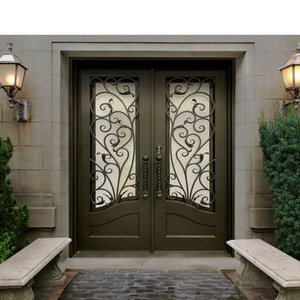
DERCHI Luxury Main Entrance Security Door With Glass Wrought Iron Large Entrance Front Doors
Combines artisanal wrought-iron artistry with thermal-break aluminum framing and double-tempered Low-E glass for grand villa entrances.
- Frame Depth: 100mm Thermal Break
- U-Factor: 1.4 W/m²K
- Multi-Point Mechanical Lock
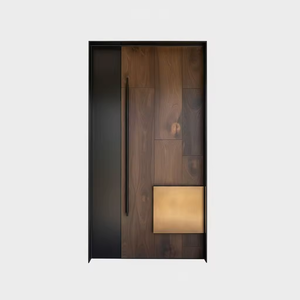
Residential Luxury Modern Pivot Main Entrance Door for Apartment Villa Exterior Front Door Digital Locking Aluminum Pivot Doors
Modern heavy-duty pivot entry system featuring biometric fingerprint smart locking, hidden floor springs, and heavy thermal insulation core.
- Biometric 3D Smart Lock
- Pivot Load Capacity: 450kg
- Aerogel Thermal Infill
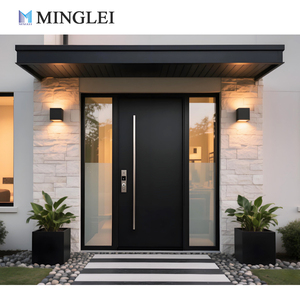
Residential Villa Home Luxury Entrance Double Entryways Doors Aluminum by MINGLEI
Architectural-grade double entrance doors engineered for high wind-load areas with dual perimeter weather seals and fluoropolymer finish.
- High Wind Resistance DP65
- AAMA 2605 Powder Coat
- Triple EPDM Compression Seal
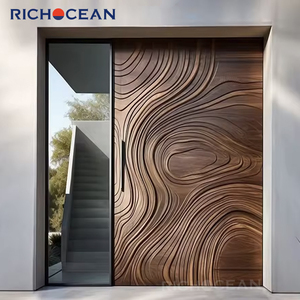
RICHOCEAN Large Villa Anti-theft Cast Aluminum Entrance Pivot Doors 3D Carving Safety Front Entry Door
Heavy duty 3D sculpted cast aluminum exterior shell over a polyurethane insulated core, offering maximum burglar protection and thermal retention.
- Bulletproof & Anti-Pry Core
- 3D Carved Solid Panel
- STC Rating: 42 dB
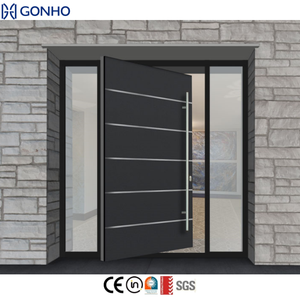
WANJIA Modern Waterproof Swing Aluminium Exterior Pivot Doors Front Entry Glass Door
Minimalist contemporary front entry glass door engineered with thermal polyamide breaks and concealed drainage channels for 100% weatherproofing.
- Hidden Water Drainage
- Double Low-E Argon Glazing
- Minimalist 45mm Profile
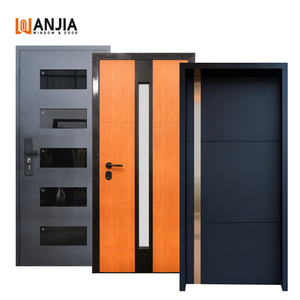
Contemporary Architectural Residential Exterior Entrance Door Sound Insulation Front Entry Doors Soundproof Security Door
Acoustically insulated entrance door designed for modern urban villas, reducing exterior noise pollution while maintaining ultra-low U-values.
- Acoustic Rating: STC 45 dB
- Multi-Chamber Insulated Core
- Drop-Down Automatic Threshold
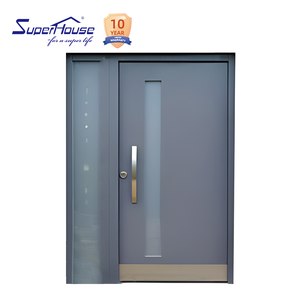
Luxury Aluminum Hurricane Impact Front Entry Door NOA FPA AAMA NFRC Certified High Wind Resistant Villa Exterior Hinged Door
Certified for extreme windborne debris zones. Features heavy laminated glass, reinforced structural framing, and Florida NOA compliance.
- Florida NOA & NFRC Certified
- Impact Laminated SGP Interlayer
- Design Pressure: ±70 PSF
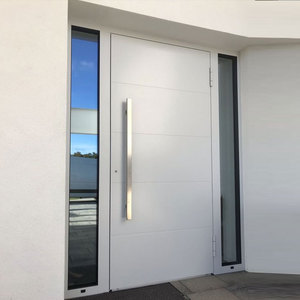
Villa Apartment Exterior Modern White Flat Panel Door Front Entry Doors Entrance Pivot Exterior Custom Doors for House
Sleek white flat-panel aluminum entrance door built with high thermal efficiency profiles, seamless joints, and customizable architectural dimensions.
- Seamless Architectural Finish
- Thermal Polyamide PA66 Strip
- Custom Sizing up to 4000mm
Why Grandor Leads China's Exterior Door Export Market
Vertical integration eliminates supply chain fragmentation. From raw ingot extrusion to export crating, every critical manufacturing stage occurs in-house under strict ISO 9001 oversight.
155,000 m² In-House Production
Grandor Door Industry Co., Ltd. operates one of Foshan's largest smart manufacturing facilities. Housing automated aluminum profile extrusion presses, vertical powder coating towers, glass tempering furnaces, and robotic profile assembly lines under a unified Quality Management System.
International Testing & Compliance
Engineered to satisfy stringent global building codes. Our insulated entry door systems carry third-party testing certifications including AS 2047 & AS 1288 (Australia), NFRC thermal ratings (USA), ASTM E283/E330/E547, and European CE (EN 14351-1) standards.
Total Customization & OEM Engineering
We work directly from architectural elevations and BIM models. Whether supplying luxury villa projects in Lake Norman (USA), steel-frame residences in Brisbane (Australia), or apartment developments, profiles, thermal break widths, glazing schedules, and hardware are tailored to exact project schedules.
Technical Advantage: Vertical Integration Eliminates Procurement Risks
Most door trading companies outsource extrusion, anodizing, or glass tempering to third-party workshops, leading to color variance, seal degradation, and compromised thermal performance. Grandor controls 100% of production in Foshan—ensuring zero tolerance deviations, single-source accountability, and direct factory pricing for overseas importers and builders.
Engineering Principles of Insulated Exterior Entry Doors
An in-depth structural and thermodynamic analysis for architects, energy consultants, and facade engineers specifying high-performance exterior entrance systems.
1. Thermal Bridge Interruption (PA66-GF25)
Aluminum exhibits a high natural thermal conductivity ($k \approx 160-200 \text{ W/m}\cdot\text{K}$). Standard non-thermal aluminum entry doors act as thermal bridges, resulting in severe interior heat gain in tropical climates and condensation/frost formation in cold regions.
Grandor insulated entry doors incorporate precision-engineered Polyamide (PA66-GF25) structural thermal breaks reinforced with 25% glass fiber. These low-conductivity strips ($k \approx 0.3 \text{ W/m}\cdot\text{K}$) isolate the exterior aluminum profile from the interior profile, lowering frame U-factors to $U_f \le 1.3 \text{ W/m}^2\text{K}$.
2. Multi-Chamber Core & Aerogel Infill
Beyond profile thermal breaks, the interior cavities of our panel doors are injected with high-density polyurethane (PU) foam ($48 \text{ kg/m}^3$) or nano-aerogel insulation boards. Aerogel infill provides a thermal conductivity of just $0.015 \text{ W/m}\cdot\text{K}$.
This multi-chamber structural core impedes conductive, convective, and radiative heat transfer across the door leaf, ensuring that grand oversized entrance doors up to 4.5 meters in height achieve whole-door thermal performance of $U_d \le 0.95 \text{ W/m}^2\text{K}$.
| Performance Standard / Specification | Standard Non-Break Aluminum Door | Steel Insulated Front Door | Grandor Thermal-Break Aluminum Entry Door |
|---|---|---|---|
| Overall U-Factor Rating ($U_d$) | 3.5 – 4.8 W/m²K (Poor) | 1.8 – 2.4 W/m²K (Moderate) | 0.85 – 1.3 W/m²K (Superior Energy Star Rating) |
| Acoustic Insulation (Sound Reduction) | STC 25 – 28 dB | STC 32 – 35 dB | STC 42 – 46 dB (Double Gasket & Laminated Glass) |
| Corrosion Resistance & Longevity | Moderate (Oxidizes over time) | Poor (Prone to rust at joints/bottoms) | Exceptional (AAMA 2605 Fluoropolymer Finish, 30+ Yrs) |
| Structural Wind Load (ASTM E330) | 1500 Pa (DP30) | 2500 Pa (DP50) | Up to 5000 Pa (DP70 / Florida NOA Impact Rated) |
| Multi-Point Security & Smart Integration | Single-Point Mechanical Lock | Standard Deadbolt | 3D Biometric / 5-Point Anti-Pry Gear Locking System |
Future Procurement & Product Development Trends
Key market forces shaping global demand for Chinese insulated entry doors over the next decade.
Future Procurement Trends
1. Carbon Transparency & Environmental Product Declarations (EPD): Institutional buyers in North America, Europe, and Australia are requiring low-embodied-carbon certifications. Procurement strategies favor manufacturers utilizing recycled aluminum billets and green powder coatings.
2. Smart Access & Automated Building Management (BMS) Integration: B2B importers are shifting away from standalone mechanical doors toward factory-integrated smart access systems (facial recognition, motorized auto-close pivot hinges, app-controlled access).
3. Prefabricated Modular Fastening Systems: Jobsite labor costs in Australia, Europe, and the US have escalated. Global buyers prefer fully pre-hung door packages with pre-milled subframes and plug-and-play drop-down weather seals.
Product Development Trends
1. Heavy-Load Gravity Pivot Hardware Engineering: Architecture demands taller, wider entryways (up to 2000mm wide by 4000mm high). Development centers on oil-immersed self-balancing pivot hinges capable of smoothly carrying 500kg leaves.
2. Thermal-Break Cast Aluminum 3D Carving: Merging the luxury anti-burglary aesthetics of solid cast aluminum plates with inner thermal breaks, giving luxury villas both maximum physical security and zero condensation.
3. Vacuum Insulated Glass (VIG) Hybrid Integration: Replacing heavy triple glazing with 8mm Vacuum Glass units achieving center-of-glass $U$-values down to $0.60 \text{ W/m}^2\text{K}$, drastically reducing door weight while improving thermal insulation.
Frequently Asked Questions for Importers & Developers
Clear technical and commercial guidance derived from 16+ years of international export engineering.
What specific technical data is required for Grandor to issue an accurate factory quotation?
1. Architectural elevations or CAD shop drawings indicating rough opening (RO) dimensions.
2. Door schedule specifying opening direction (inward/outward swing or offset pivot).
3. Required thermal performance metrics (Target U-Factor, SHGC, or local energy compliance rules like Title 24, NCC Australia, or CE).
4. Glass specification (Double/Triple Low-E, Argon gas, tempered, or SGP hurricane impact laminated).
5. Frame finish requirements (AAMA 2604/2605 powder coat, wood-grain thermal transfer, or anodized).
6. Destination seaport for freight and container load optimization.
Why choose thermal-break aluminum entry doors over traditional wood or steel doors?
Can Grandor engineer custom door dimensions, colors, and hardware for specific overseas markets?
How does Grandor ensure safe ocean transport and prevent shipping damage for glass entry doors?
What is your typical production lead time for custom wholesale and project orders?
Partner with China's Premier Insulated Entry Door Manufacturer
Elevate your architectural portfolio with factory-direct pricing, certified thermal performance, and engineering expertise. Contact our project engineering team today for shop drawing reviews, samples, and wholesale quotations.
Contact Us