Sourcing Thermal Break Aluminum Doors from China: Strategic Executive Summary
As global architectural trends shift toward ultra-low energy consumption, structural slim sightlines, and extreme climatic resilience, thermal break aluminum doors have emerged as the cornerstone of high-performance residential and commercial building envelopes. China accounts for over 55% of the world's architectural aluminum profile extrusions, housing the most technologically advanced manufacturing clusters in Foshan, Guangdong. This whitepaper provides commercial procurement managers, architects, real estate developers, and wholesale importers with an authoritative evaluation framework for selecting tier-1 Chinese thermal break aluminum door manufacturers.
Standard aluminum alloy is a high-conductivity material ($K \approx 160-200\text{ W/m}\cdot\text{K}$). A genuine thermal break system structural frame integrates an extruded structural polyamide strip (PA66-GF25: 66% Polyamide reinforced with 25% Glass Fiber) separating the exterior and interior aluminum profiles. This creates an isolated thermal barrier, lowering the frame $U$-factor from $>5.8\text{ W/m}^2\text{K}$ down to $<1.6\text{ W/m}^2\text{K}$ when coupled with double or triple Low-E insulated glass units (IGUs).
Featured Export-Grade Thermal Break Aluminum Doors
Below is an engineered selection of factory-direct entrance, patio, pivot, and balcony door systems tested for international structural compliance (AS2047, NFRC, ASTM E330, CE EN 14351-1, Miami-Dade NOA).
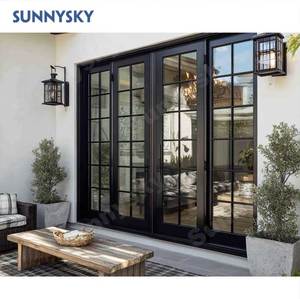
Sunnysky Wholesale Main Entrance Exterior French Double Glazed Swing Door
- Profile: 2.0mm Thermal Break 6063-T6
- Glass: 5mm+12Ar+5mm Double Low-E
- Hardware: German SIEGENIA Multi-Point
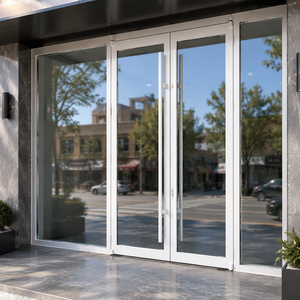
Windproof Exterior Thermal Break Double Front Aluminum Spring Hinged Door
- Seal: EPDM Dual-Coextrusion Gasket
- Air Tightness: Class 4 (EN 12207)
- Thermal Strip: Technoform PA66GF25
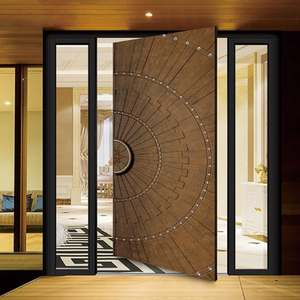
Customizable Aluminum Double Pivot Door with Smart Lock for Villa Main Entry
- Hinge: Heavy Duty 500kg Hidden Pivot
- Security: 3D Biometric Smart Lock
- Finish: Fluorocarbon PVDF Coating
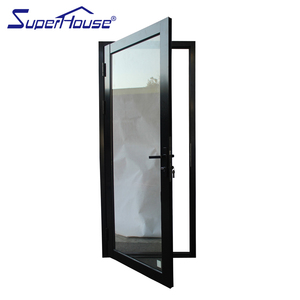
Miami NOA Approved Hurricane Proof Triple Glazed Impact Resistance Patio Door
- Impact Rating: Miami-Dade NOA Tested
- Glass: 6mm Temp + 1.52PVB + 6mm
- Wind Pressure: Up to 5000 Pa (ASTM E330)
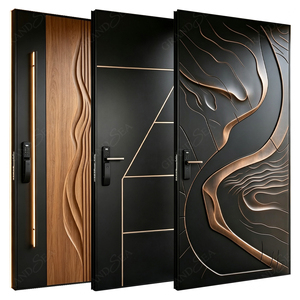
Luxury Exterior Swing Steel Pivot Front Armored Cast Aluminum Security Entrance
- Structure: Cast Aluminum + Steel Core
- Anti-Burglary: RC3 / WK3 Class Rated
- Acoustic Isolation: STC 42 dB
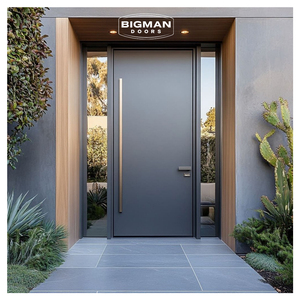
British Minimalist Dark Grey Matte Security Pivot Door Anti-Theft Villa Entry
- Design: Flush Minimalist Sightlines
- Finish: AkzoNobel Powder Coat
- Locking: 5-Point Automatic Latch
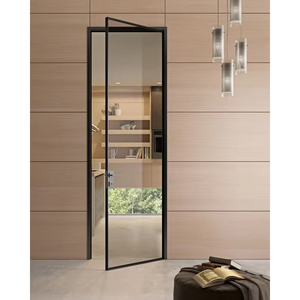
Narrow Frame Aluminum Glass Hinged Casement Door with Stainless Mesh
- Frame Width: Ultra-narrow 16mm Face
- Mesh: 304 High-Clarity Flyscreen
- Application: Exterior Patio / Interior
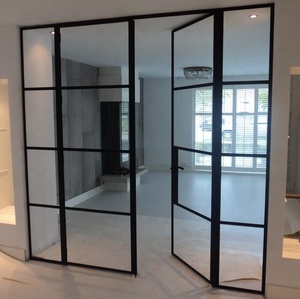
HOTIAN French Black Balcony Patio Wrought Iron Style Crittall Swing Door
- Style: Industrial Crittall Grid
- Glazing: Tempered Clear / Fluted
- Corrosion: C4 Grade Coastal Coating
Enterprise Capabilities: Why Premier Global Buyers Partner with Integrated Chinese Factories
Evaluating door manufacturers requires peeling back the curtain on supply chain integration. Small assembly shops often outsource extrusion, powder coating, and glass tempering to third parties, resulting in quality variances, delayed lead times, and uncoordinated warranties. Integrated industry leaders control every critical process under one roof.
In-House Profile Extrusion & Alloy Selection
Premier Foshan manufacturers utilize high-purity primary aluminum ingots to extrude architectural-grade 6063-T6 aluminum alloy profiles with precise wall thicknesses (ranging from 1.4mm to 3.0mm depending on structural load needs). In-house extrusion guarantees uniform grain structure, tensile strength exceeding $205\text{ MPa}$, and precise dimensional tolerances matching strict ISO 9001 quality frameworks.
Advanced Surface Finishes & Coating Lines
Direct factory ownership of vertical powder coating lines, anodizing baths, fluorocarbon PVDF spraying, and Italian 3D vacuum heat-transfer wood-grain technology ensures superior weatherability. Coatings achieve AAMA 2604 / AAMA 2605 compliance, offering high resistance to UV degradation, salt spray corrosion (C4/C5 marine environments), and color fading over a 20+ year service life.
Integrated Glass Tempering & IGU Assembly
In-house glass processing facilities feature automated cutting, edgeworking, tempering furnaces, and dual-seal insulated glass unit (IGU) lines. By filling argon gas ($>90\%$ concentration) into warm-edge spacer cavities and applying double Low-E magnetron sputtering, integrated factories maintain strict control over optical clarity, thermal performance, and seal longevity against fogging.
Comparative Analysis: Integrated OEM Factory vs. Small Subcontracting Workshops
| Evaluation Parameter | Integrated OEM Manufacturer (e.g., Grandor Factory Model) | Small Subcontracted Assembly Workshops |
|---|---|---|
| Supply Chain Ownership | 100% In-house Extrusion, Coating, Glass & Assembly (155,000m²) | Outsourced profiles, glass, and surface treatment to 3rd party vendors |
| Quality & Traceability | ISO 9001 unified batch tracking from aluminum billet to final packing | Fragmented quality control; varying profile wall thickness and alloy purity |
| Thermal Strip Specification | Precision-inserted PA66-GF25 Polyamide structural insulation strips | Low-cost PVC or recycled plastic strips prone to brittleness and thermal leakage |
| Testing & Compliance | In-house NFRC, AS2047, CE, ASTM pressure/water testing chambers | No internal testing facilities; relies on unverified vendor claims |
| Customization & Shop Drawings | Dedicated BIM/AutoCAD engineering team for custom architectural details | Limited to standard stock sizes and rudimentary manual assembly |
| Production Lead Times | Predictable 20-30 days cycle via synchronized in-house scheduling | Frequent delays caused by supply bottlenecks from external suppliers |
Engineering Deep-Dive: Physics of Thermal Break Technology & Structural Ratings
To select the right profile specifications for diverse climatic regions—ranging from sub-zero Northern European conditions to high-humidity, hurricane-prone tropical zones—procurement managers must analyze key structural and thermal metrics.
1. Thermal Performance Metrics ($U$-Factor, SHGC, $R$-Value)
The overall thermal performance of an aluminum door is designated by its thermal transmittance value ($U$-factor, measured in $\text{W/m}^2\text{K}$ or $\text{Btu/h}\cdot\text{ft}^2\cdot^\circ\text{F}$). A lower $U$-factor signifies superior insulation capability.
- Standard Thermal Break ($U$-value 1.8 - 2.2 W/m²K): Suitable for temperate climates, utilizing 20mm-24mm PA66-GF25 thermal strips and double Low-E IGUs.
- Passive House Ultra-Insulated ($U$-value 0.8 - 1.2 W/m²K): Designed for extreme cold, featuring multi-cavity thermal strips infused with aerogel insulation, combined with triple-pane Low-E glass and krypton/argon gas fill.
- Solar Heat Gain Coefficient (SHGC): Controls the fraction of solar radiation admitted through the glass. In tropical zones, specifying an SHGC $< 0.25$ significantly reduces HVAC cooling loads.
2. Acoustic Isolation & Structural Wind Load Resistance
Beyond heat retention, exterior entrance and patio doors must withstand severe mechanical forces and acoustic pollution.
- Structural Wind Load (ASTM E330 / AS2047): Heavy-duty commercial profile designs engineered with internal corner crimping and stainless steel reinforced cleats withstand ultimate pressures up to $5000\text{ Pa}$ (equivalent to Category 5 hurricane force winds).
- Water Penetration Resistance (ASTM E547): Multi-chambered internal drainage channels with concealed pressure-equalized flap valves prevent water ingress at test pressures $>700\text{ Pa}$.
- Sound Transmission Class (STC / Rw): Utilizing acoustic PVB laminated glass and co-extruded EPDM weatherstripping reduces ambient noise by up to $42\text{ dB}$, converting noisy urban environments into quiet interior spaces.
Future Procurement Trends for Thermal Break Aluminum Doors (2025–2030)
Market intelligence indicates rapid technological transformations in building envelope specifications. B2B buyers who align their product lines with these key emerging trends gain a decisive competitive edge.
1. Ultra-Slim Sightlines & Oversized Glass Panels
Modern minimalist architecture demands maximum daylight and panoramic views. Next-generation thermal break systems utilize high-tensile 6063-T6 aluminum alloys that maintain structural rigidity even with ultra-thin frame faces (16mm - 21mm) supporting heavy glass weights up to 600kg per panel.
2. Smart Home & Biometric Security Integration
Entrance doors are evolving into intelligent security hubs. Procurement is shifting toward doors pre-engineered for motorized multi-point automatic locks, facial recognition sensors, fingerprint scanners, and smart home IoT automation compatibility (Zigbee, Z-Wave, Matter protocols).
3. Carbon-Neutral Hydro-Aluminum & EPD Certification
With European CBAM (Carbon Border Adjustment Mechanism) and global ESG standards taking effect, top buyers now mandate Environmental Product Declarations (EPDs). Factories utilizing low-carbon hydroelectricity for aluminum smelting gain preference in international tenders.
4. Extreme Weather & Impact Resiliency
Increasing frequency of coastal storms is driving global demand for hurricane-impact certified doors. Sourcing focuses on laminated glass configurations with high-performance SentryGlas® (SGP) interlayers and structural adhesive glazing designed to survive missile impact testing.
Technological Development Trends in Aluminum Door Manufacturing
Continuous engineering innovation in Chinese manufacturing hubs is redefining product capabilities across four core technical domains:
Advanced Thermal Cavity Engineering
Traditional single-chamber thermal break profiles are being rapidly superseded by multi-cavity isolators. Modern profiles integrate internal polyolefin foam insulation inserts, low-emissivity thermal reflective foils inside the cavities, and center gasket seals with co-extruded hollow chambers. These innovations dramatically suppress internal convective heat transfer, enabling profile U-values as low as $1.0\text{ W/m}^2\text{K}$.
Precision Hardware & Concealed System Hardware
Technological advances in concealed 3D adjustable heavy-duty hinges allow door sashes to operate effortlessly while remaining completely hidden when closed. Multi-point locking mechanisms feature anti-lift hooks, hardened steel security bolts, and magnetic latching systems that provide whisper-quiet closure and high resistance against forced entry.
Frequently Asked Questions (FAQ) for B2B Importers & Contractors
Below are expert answers to critical technical and logistical questions faced during overseas window and door procurement from Chinese suppliers.
What technical drawings and information are required to get an accurate factory proposal? +
- Architectural elevations or CAD shop drawings with clear rough opening (RO) dimensions.
- A window and door schedule detailing opening types (e.g., casement, sliding, bi-fold, pivot).
- Thermal, wind load, and acoustic performance targets (e.g., target U-factor, STC rating, wind pressure Pa).
- Frame finish preferences (Powder coat color code RAL, Fluorocarbon PVDF, Wood-Grain) and glass build-ups (e.g., 6mm Low-E + 12Ar + 6mm Clear).
- Destination port, local compliance standard requirements (AS2047, NFRC, CE), and target delivery timelines.
Why are Thermal Break Aluminum Doors vastly superior to standard non-thermal aluminum profiles? +
Can Chinese factories customize door sizes, profile colors, glass specs, and hardware for local market standards? +
What export packaging standards are used to protect glass and coated frames during ocean freight? +
- Protective adhesive blue film on all exposed aluminum profile surfaces.
- Corner protective caps on all door sashes.
- Shock-absorbing EPE foam wrapping around entire frame assemblies.
- Heavy-duty corrugated cardboard outer wrapping.
- Fumigated solid wooden crates or steel-reinforced plywood pallets with moisture-absorbing desiccant packs, secured with steel banding to withstand container motion during long-distance sea transportation.
How do premier Chinese factories guarantee compliance with international standards such as AS2047, NFRC, or CE? +
Ready to Elevate Your Architectural Project or Wholesale Line?
Consult with our senior fenestration engineers to receive custom CAD shop drawings, technical compliance verification, structural wind load calculations, and competitive direct-factory pricing.