Featured Thermal Break & High-Security Entry Door Systems
Explore enterprise-grade exterior entrance solutions engineered with multi-chamber thermal breaks, acoustic damping cores, and advanced multi-point security hardware.
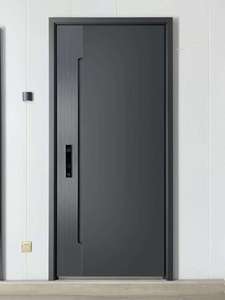
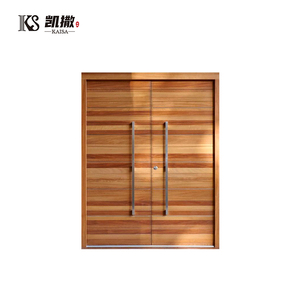
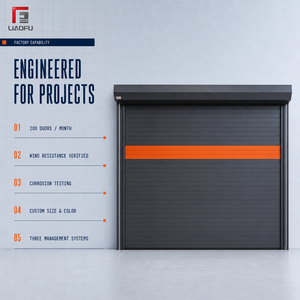
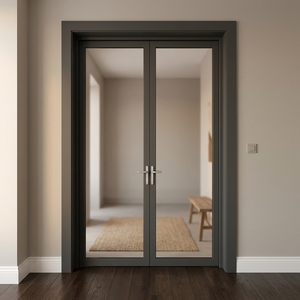
Executive Summary: The Evolution of Thermal Break Aluminum Entry Systems
In modern architectural design and low-energy building construction, entry doors represent a critical nexus of energy conservation, structural resilience, and architectural expression.
Historically, exterior metal doors suffered from high thermal conductivity, resulting in significant energy losses, internal condensation, and compromised indoor climate control. The introduction of polyamide thermal break technology (PA66-GF25) transformed aluminum from a thermally conductive structural material into an energy-efficient architectural solution. By structurally separating the interior and exterior aluminum profiles with glass-fiber reinforced polyamide struts, elite manufacturers effectively stop continuous thermal bridges.
For international procurement specialists, real estate developers, and architectural specifiers, selecting top-tier thermal break aluminum entry door manufacturers requires analyzing technical parameters beyond superficial aesthetics. A door must maintain dimensional stability under extreme solar exposure, resist gale-force wind pressures, provide STC 40+ sound reduction, and feature multi-point anti-burglary locking mechanics—all while delivering smooth operation for decades.
Technical Breakdown of Recommended Entry Door Typologies
Evaluating profile geometry, thermal insulation cores, and hardware engineering across high-demand entry door configurations.
Heavy-Duty Architectural Pivot Doors
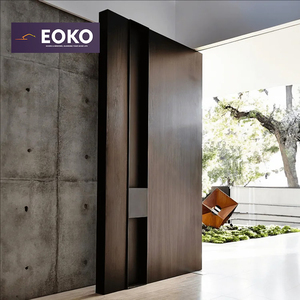
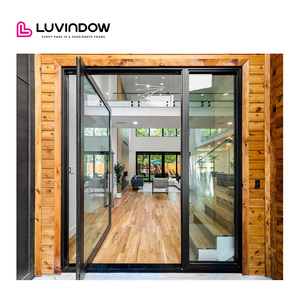
Engineered for large-scale modern luxury entrances. Pivot hinges offset load weight directly into the structural floor slab, supporting oversized panels up to 3000mm in height.
- Custom multi-cavity thermal break profiles
- Concealed heavy-load floor pivot system (up to 500kg)
- Integrated perimeter magnetic weather seals
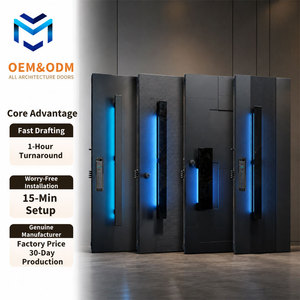
- Biometric smart lock and LED accent lighting options
High-Security Double French Entry Doors
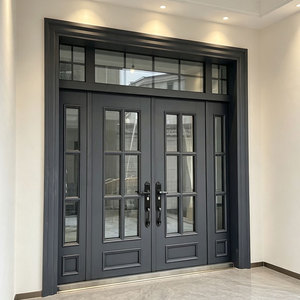
Combining symmetrical elegance with reinforced anti-burglar defense. Designed for grand villa portals requiring wide clear-opening dimensions and maximum weather resistance.
- Zinc-alloy & T6063-T6 aluminum composite frames
- Multi-point gear locks with hardened steel bolts
- Triple-glazed Low-E argon filled safety glass
- Qualicoat Class 2 powder coating / PVDF finish
Acoustic & Fire-Rated Cast Aluminum Doors
Designed for environments requiring acoustic isolation and elevated fire safety. Utilizes polyurethane foam core insulation combined with heavy-gauge solid cast aluminum fascia panels.
- Sound Transmission Class (STC) rating up to 45dB
- Flame-retardant structural core insulation
- High impact resistance against mechanical intrusion
- Precision wood-grain sublimation transfers
Enterprise Manufacturing Strength: Grandor Door Industry Co., Ltd.
Providing single-source manufacturing accountability from raw aluminum extrusion to precision export packaging.
As a global manufacturing leader operating out of a 155,000 m² smart production base in Foshan, Guangdong, Grandor Door Industry Co., Ltd. resolves the fundamental supply chain risks faced by international door and window buyers. Many suppliers rely on fragmented subcontractors for extrusions, powder coating, or glass tempering—introducing quality control variations and unpredictable delays. Grandor executes every core production process completely in-house.
In-House Aluminum Extrusion
Operating multiple heavy extrusion presses utilizing high-purity primary 6063-T6 aluminum billets, guaranteeing precise profile wall thickness and mechanical yield strength exceeding 160 MPa.
Automated Surface Treatment
State-of-the-art vertical powder coating and fluorocarbon PVDF lines ensuring uniform film thickness (>60 microns), weatherability against high UV exposure, and salt-spray resistance (>1000 hours).
Precision Glass Tempering & IGU
Integrated automated insulating glass unit (IGU) lines producing double and triple-glazed tempered glass panels featuring warm-edge spacers, argon gas filling, and Low-E selective coatings.
Engineering Benchmark & Material Specifications
Comparative analysis of Grandor thermal break entrance door performance against standard architectural industry benchmarks.
| Performance Vector | Standard Aluminum Door | Grandor Thermal Break System | International Standard Complied |
|---|---|---|---|
| Thermal Transmittance ($U_f$) | 3.5 - 5.8 W/(m²·K) | 1.1 - 1.8 W/(m²·K) | NFRC / EN ISO 10077-2 |
| Acoustic Damping (STC) | 22 - 28 dB | 38 - 45+ dB | ASTM E90 / ISO 10140 |
| Air Infiltration Resistance | Class 2 (300 Pa) | Class 4 (600 Pa) | ASTM E283 / EN 12207 |
| Water Penetration Pressure | 150 - 250 Pa | 600 - 900 Pa | ASTM E547 / EN 12208 |
| Structural Wind Load | 1.5 - 2.5 kPa | 4.0 - 5.5 kPa (Cyclonic Rated) | ASTM E330 / AS 2047 |
| Security & Intrusion Rating | Single Latch Lock | 5-Point Automatic Gear Lock | EN 1627 RC3 / PAS 24 |
Future Procurement Trends in Thermal Break Entrance Systems (2025–2030)
Key market shifts driving architectural specifications for luxury residential and commercial entry doors worldwide.
1. Passivhaus & Carbon Neutral Energy Directives
Global building codes (such as Europe's EPBD and North America's IECC) demand lower whole-building carbon footprints. Future entrance doors must achieve whole-assembly $U$-factors under 1.0 W/(m²·K). This relies on multi-cavity thermal break struts injected with aerogel or high-density polyurethane insulation.
2. Fully Integrated Smart Access Architecture
Mechanical keys are rapidly giving way to motorized multi-point locking systems. Procurement requirements now emphasize factory-integrated biometrics (3D facial recognition, palm vein scanning) and smart home automation integration (Zigbee, Matter, KNX) wired invisibly through aluminum frame raceways.
3. Oversized Minimalist Sightlines & Flush Sills
Architects are demanding larger entrance openings with minimal visible aluminum frames. Zero-threshold flush drainage sills that satisfy ADA mobility requirements while preventing water backflow under 600 Pa storm pressure represent a critical competitive differentiator.
B2B Sourcing FAQ: Thermal Break Aluminum Entry Doors
Addressing essential technical, commercial, and quality assurance questions for international buyers.
What parameters are required to generate an accurate architectural quotation?
To prepare a precise shop drawing and commercial proposal, please provide: (1) Architectural opening dimensions or floor plan elevations; (2) Door operation type (pivot, double swing, single entry); (3) Target performance metrics (U-value, wind load, STC acoustic rating); (4) Frame surface finish preference (Qualicoat powder coating, wood-grain transfer, PVDF); (5) Glass specification (e.g., 6mm Low-E + 12Ar + 6mm Tempered); and (6) Project location for local compliance review.
Why is a thermal break essential for aluminum entry doors compared to solid metal?
Aluminum is a highly conductive metal with a thermal conductivity of approx. 160-200 W/(m·K). Without a thermal break, outdoor cold or heat conducts directly into the building, causing high energy consumption and interior frame condensation that damages flooring and drywall. Inserting structural polyamide strips (PA66-GF25 with a thermal conductivity of only 0.3 W/(m·K)) creates a robust thermal barrier, drastically improving insulation performance.
Can Grandor customize frame profiles, finishes, and locking hardware for regional market codes?
Yes. Because Grandor manages complete in-house extrusion, anodizing, powder coating, and precision CNC machining, systems can be customized to comply with regional standards—including Australian AS 2047 / AS 1288 standards, European CE EN 14351-1 benchmarks, and North American NFRC / ASTM structural testing protocols.
How are oversized aluminum pivot doors engineered against frame warping under heat?
Large exterior aluminum doors subjected to strong direct sunlight can experience thermal expansion differences between the outer skin (hot) and inner skin (cool), causing "bimetallic bending". Grandor mitigates this by using anti-bi-metal polyamide thermal break struts that allow minor independent movement between inner and outer profiles, maintaining perfect frame alignment and lock engagement under all weather conditions.
What packaging and shipping safeguards prevent transit damage during ocean freight?
All export orders are protected by a multi-layer packaging protocol: (1) Protective film applied to coated aluminum profile surfaces; (2) High-density EPDM corner guards; (3) Fully enclosed bubble wrap insulation; and (4) Fumigation-free custom plywood crates with internal steel strapping to prevent movement during containerized ocean freight.
Partner with a Leading China Thermal Break Entry Door Factory
Consult with our structural engineering team, review factory shop drawings, and request complete technical catalog files for your upcoming residential or commercial development.
Get Catalog